This April, we're spotlighting the scientists driving change for bone cancer patients, including Professor Robin Plevin at the University of Strathclyde.
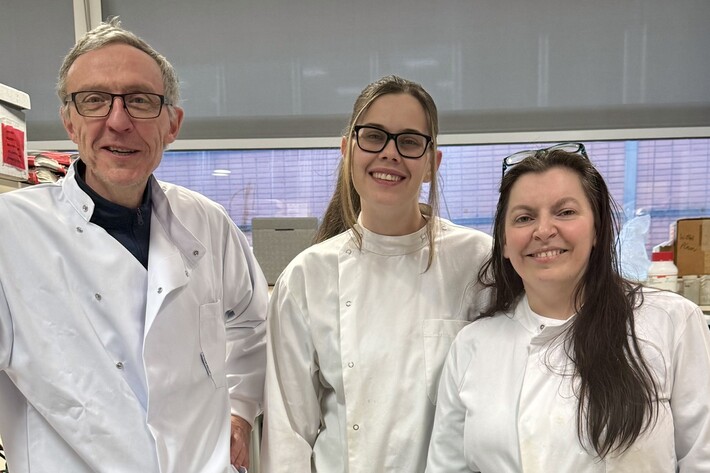
A pharmacologist by trade, Professor Plevin's work into how osteosarcoma resists treatment could pave the way for more personalised and effective care. Below, he explains why cell signalling is like a relay race and shares the item in his bag that may surprise you!
Please can you give us an overview of your BCRT and CCLG-funded research project?
My laboratory's interested in a protein known as inhibitory B kinase alpha (IKKα). This protein is involved in a well-described pathway known as the NF-kappa B pathway, which plays a part in the development of inflammation and cancer.
By looking at this pathway in osteosarcoma, we found there was hardly any significant research done in this area. Initially, we were looking at osteosarcoma cell lines and the role of IKKα in inflammation.
In doing so, we found this protein is potentially involved in the development of osteosarcoma. This, of course, requires further exploration and examination.
Additionally, we have already developed chemical molecules that can block or inhibit the IKKα protein. We've come to the project from a strange angle relative to the discovery and development of new drugs, since we already have selective IKKα inhibitors.
So, we're in an ideal position to try and work out 1) whether IKKα has a role and 2) if so, whether the drugs we've developed have the potential to treat osteosarcoma.
Can you tell us about your career and how it led you to the University of Strathclyde?
I studied my first degree at the University of Edinburgh, not quite knowing which discipline within biological sciences that I wanted to go into.
My favourite discipline at university quickly became pharmacology. I persisted in this area with my PhD at the University of Southampton and two post-doctoral positions — one at the university of Leicester and the other at the University of Glasgow. At the time, science was developing to understand more about intercellular signalling and what goes on inside the cell.
Traditional pharmacology started to coincide with cellular biochemistry. This really appealed to me and was why I wanted to pursue it. Through my two post-doctoral degrees, that was the theme: understanding these pathways and trying to think of drugs that could inhibit them.
This is how I ended up here at the University of Strathclyde. They specialise in traditional pharmacology, but are interested in modernising. This enabled me to take a more modern approach and help grow research at Strathclyde many decades ago... and I'm still here today!
How would you explain cell signalling and inflammation to someone outside of science?
Cell signalling is the "middle bit." What I mean by that is, in your body, you are stimulated by lots of different hormones. For example, adrenaline. This makes your heart beat faster and contract more.
Signalling is what happens inside the cell that joins up the adrenaline hitting your heart cells and your heart giving the outcome, i.e. beating faster. Here, we are interested in what happens inside the cell once the agent has hit the cell to cause the output.
It's a bit like a relay race. When the gun goes, that's when the agent hits the cell, but then you have a relay of things happening before you get to that finish line. That's signalling — a series of biochemical events that are handing down information to the cell to do something. It could be short-term, like your heartrate increasing, or it could be long-term such as muscle growth or cells growing inside your body.
Inflammation is your response to something which causes damage to the body, such as an infection. For example, if you injure yourself by hitting your knee, this causes damage and your body has to respond to that damage by bringing in immune cells, increasing blood flow, and swelling. This happens in a way in which you can see it, but it also happens inside your body.
This includes asthma, which is an inflammatory condition because you develop more mucus and problems with your airway. When inflammation happens, it can contribute to a number of diseases, including cancer. This is because the inflammatory environment helps cancer cells to grow.
Inflammation isn't a trigger for cancer as such, but it is an environment that you want to avoid. If you can create something that inhibits the growth of cancer cells and avoid inflammation as well, that's a good thing.
Our project includes both of these elements — inhibiting the cell to stop cancer cells, but also stopping the molecules that help create an inflammatory environment. While this is normally a good or protective space, in chronic diseases like cancer, it is a bad environment.
How has the field of pharmacology evolved since the start of your career?
When I started out, it was known as a classic period of pharmacology in which very famous pharmacologists were discovering the fundamental things, particularly around blocking the molecules on the surface of cells (known as receptors) to develop classical drugs such as antihistamines and beta blockers.
Now of course, because our understanding of biology within the cell is much more expansive, the number of targets has increased greatly. We have expanded the number of different targets to develop drugs, virtually every protein inside or outside the cell can be viewed as a target nowadays.
Secondly, classical drugs such as antihistamines are known as small molecules. Today, people make things called antibodies. You make an antibody when you get an infection, and it recognises part of the infectious molecule and is able to kill it. However, we can use biotechnology and make synthetic antibodies to treat disease.
Do you have any advice for aspiring scientists and early career researchers?
If you have a passion for conducting research, stick with it, and learn your trade. I'm still learning, and being a scientist is a long journey in terms of becoming an expert.
Another important thing is to do your work thoroughly. Nowadays, with the pressure to publish and farming out to small companies and pharmacies, it can sometimes cause an expertise gap.
It's always a good thing to learn things yourself and learn them thoroughly, then you become an expert. Having a passion for science when things don't go well is very important, alongside being a self-critical thinker.
If you weren't a scientist, what do you think you would be doing instead?
Many years ago, I was an international hockey player. I used to play for Scotland at varying levels. Nowadays, hockey is much more a professional sport than it used to be at the higher levels.
If I wasn't doing research, which is my main passion, I maybe would have done something in sports like coaching.
What do you like to do when you're not in the lab?
I love drama and poetry. I like to engage the right side of my brain — around fifteen years ago I wrote a one-act play called the Angina Monologues which was about heart health. It toured around Glasgow, and was even shortlisted for a Times Higher Education Award.
I really enjoy going to the theatre. A few years ago, I did stand-up comedy in Glasgow at The Stand Comedy Club. I'm also a bit of an art collector; I have two or three pieces created by students who were artists as well as PhD students. I feel very inspired by how creative people can be.
What's one fact that your students or colleagues would be surprised to learn about you?
In my bag, I always have a poem or piece from a play that I try to learn. For example, I'd pick a Shakespearean monologue that I would study in a café, sitting on a bus etc. It comes from a love of literature and drama, but also helps test your memory too.
Do you have a message for patients going through treatment?
As someone from outside of the bone sarcoma discipline who works in pharmacology, it was a real shock to me how difficult, challenging, and painful treatments are.
It opened my eyes to how many different groups of people it affects, which really galvanised my ideas of how to help develop treatments. You wouldn't wish the condition on anyone, but I was shocked at how it affects both children and adults.
I hope that my research will help make a difference. We are working on very fundamental research, but I hope that it will be of added value to the current research into new treatments.
Learn more about Professor Plevin's pioneering work at the link below: