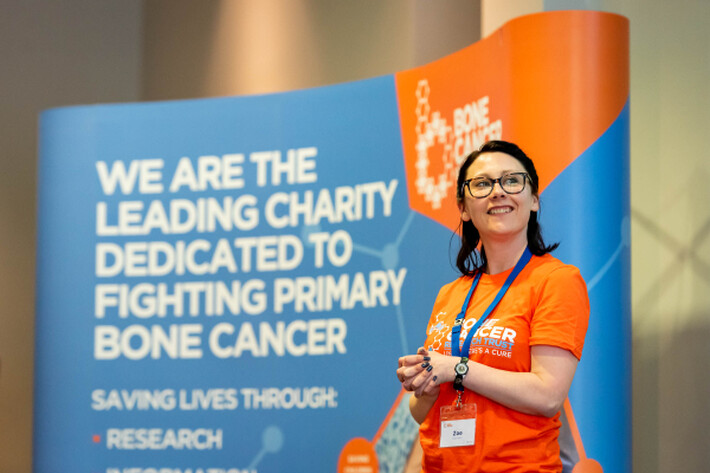
Following international recognition at the SPAGN Advocacy in Action Awards, including the Paola Gonzato Memory Award for bone sarcoma advocacy, we spoke to Dr Zoe Davison, Director of Research and Information, about the charity’s growing global impact.
Why did the Bone Cancer Research Trust (BCRT) decide to join SPAGN?
Primary bone cancer, or bone sarcoma, is a rare disease, which means collaboration is essential if we want to make progress. Joining SPAGN allows us to connect with more than 60 organisations globally, all focused on improving outcomes for sarcoma patients and giving sarcoma patients a voice.
SPAGN provides a platform to ensure that primary bone cancer patients are at the heart of the research that takes place globally; to share knowledge, align priorities, and strengthen advocacy. By being a member, we can capitalise on opportunities for collaboration in research, accelerating progress and maximising what we can achieve as a charity .
How has BCRT been involved in SPAGN since joining?
BCRT joined SPAGN in 2018 and we’ve been actively involved through awareness campaigns, collaborative projects, and by contributing to global research and advocacy discussions.
A recent highlight was being recognised through the SPAGN Advocacy in Action Awards, including the Paola Gonzato Memory Award, which specifically honours innovative advocacy work in bone sarcoma.
This recognition reflects our commitment to patient-driven advocacy as part of the Euro Ewing Consortium, bringing together communities, raising awareness, and driving meaningful change.
Over the years, BCRT has also been recognised for our annual Bone Cancer Conference, the Bone Cancer Awareness Initiative alongside Children with Cancer UK, our 2024 Bone Cancer Awareness Week campaign Ever Heard of Bone Cancer, and the National Sarcoma Awareness Project aimed at educating medical students and resident doctors.
In 2025, I was also appointed to the steering committee of the Bone Sarcoma Alliance, an initiative to support international collaboration, knowledge-sharing, and unified action in research and advocacy.
What are the aims of the Bone Sarcoma Alliance?
The Bone Sarcoma Alliance aims to improve outcomes for bone sarcoma patients by bringing together advocates, experts, and professionals to discuss challenges, share experiences, and build evidence to accelerate progress in treatment and quality of life. It gives the patient community an opportunity to influence research as one voice, addressing common concerns and working together to create solutions.
Why is this important for the bone cancer community?
Because the challenges faced by bone sarcoma patients are global.
Across countries, we see common issues, delays in diagnosis, limited treatment options, and unequal access to specialist care. These are not problems that can be solved in isolation.
SPAGN exists to bring organisations together to tackle exactly these kinds of challenges and by working collaboratively, we can share knowledge, improve awareness, and advocate more effectively for the research and care that patients need.
What difference has being a SPAGN member made?
It has significantly strengthened our impact.
Being part of a global network allows us to amplify the voice of the bone cancer community and ensure it is heard at an international level. Recognition through awards like the Paola Gonzato Memory Award highlights how important that voice is, particularly for rare cancers like bone sarcoma.
It’s also enabled us to build strong partnerships, learn from other organisations, and bring those insights back into our work in the UK.
Most importantly, it allows us to be part of a collective effort. For rare cancers, progress depends on collaboration and SPAGN provides the framework to make that happen. Recently, we have worked collectively to bring the patient perspective to a number of clinical trial applications and resources. United, we can ensure that patient involvement is meaningful and genuinely informs the priorities of the research community.
What’s next?
Our focus is to turn collaboration into action.
The outcomes from the discussions, workshops and collaborations will help shape our future research priorities and advocacy efforts, both nationally and internationally.
There is real momentum right now, and that’s exciting for BCRT and our community. Through global partnerships, patient-led advocacy, and growing recognition of the need to work together.
We aim to build on that momentum to drive meaningful improvements in diagnosis, treatment, and support for people affected by bone sarcoma.
SPAGN


